
Tuckahoe City Directory Collections
Tuckahoe has no incorporated-city clerk or standalone city-directory archive. The useful historical shelf is regional: Richmond, suburban Richmond, and Henrico material held by the Richmond Room, the Library of Virginia, and VMHC. That distinction matters. A volume can be an excellent lead for a Tuckahoe family while still omitting rural Henrico, or it can identify an address in independent Richmond rather than in the Tuckahoe CDP.
The table separates a documented run from a promise of complete coverage. It also distinguishes a named collection from a research lead. Yearly continuity varies, especially in selected online collections, so a missing year should be checked at a physical repository before it is treated as a gap in a household's history.
| Directory collection | Documented years | Where held | How to use it |
|---|---|---|---|
| Richmond Directory, Register, and Almanac | 1819; no new directory until 1845 | Library of Virginia Virginia Print collections and Richmond Room | Regional starting point; nearby rural Henrico may be absent |
| Richmond and Manchester, Chataigne & Gillis | 1877/78 through 1894/95 | Newberry finding aid and reported library or digitized holdings | Confirm the individual volume and address coverage |
| Richmond city and suburban directories | 1819-present at Richmond Room | Richmond Room, Main Library | Non-circulating, in-building research |
| VMHC Richmond directory collection | Nearly every year from 1870; specific microform runs | VMHC reference and microform collection | Check the guide and whether a volume reaches the address |
| Virginia directory selection | 1873-1960 selection | Library of Virginia access to Ancestry | Free Virginia access; selected, not every-year coverage |
For the first printed benchmark, the Library of Virginia biography of John Maddox identifies his 1819 Richmond Directory, Register, and Almanac as the first Richmond directory and his only edition. The record is Richmond-centered, so it is not proof that a Tuckahoe household was included or excluded.
Tuckahoe Historical Directory Geography
Tuckahoe is a CDP in Henrico County. Richmond is an independent city. Those labels can appear side by side in historical material, but they are not interchangeable jurisdictions. A Richmond postal label or a Richmond city-directory hit does not establish that the address lies within Richmond City, and it does not establish that it falls inside the modern Tuckahoe CDP.
Use the street address, nearby community label, and Henrico parcel or GIS geography to test a result. Search neighboring jurisdictions when a surname is absent. This is especially important for early material, because historic sources did not use the same CDP boundary or name in every period. The goal is to document what the source printed, then identify where that address belongs.
Note: A regional directory is a useful household clue, but it is not a boundary map or a complete roll of Tuckahoe residents.
Tuckahoe Historical Directory Timeline
Directory chronology gives a practical way to choose the next shelf or database. The documented milestones below come from the Library of Virginia, the Newberry finding aid, and the VMHC collection guide. They describe greater-Richmond holdings rather than a continuously published Tuckahoe series.
| 1819 | Maddox publishes the first Richmond directory; the Library of Virginia reports no directory again until 1845. |
|---|---|
| 1870 onward | VMHC reports Richmond directories for nearly every year from 1870. |
| 1877/78-1894/95 | The Newberry finding aid documents the Chataigne & Gillis Richmond and Manchester annual runs. |
| 1879-80 | VMHC reports a street-address section arranged by street, then house number. |
| 1882/83-1935 | VMHC lists microfilm coverage in two runs: 1882/83-1901 and 1902/03-1935. |
| 1936-current | VMHC identifies reference call number F234.5 R5 for this directory sequence. |
The comparison is useful: current parcel and GIS layers are strongest for recent property facts, while the Richmond Room, VMHC, and Library of Virginia are stronger for pre-digital household reconstruction. Neither record layer reaches the whole Tuckahoe history by itself.
Reading Tuckahoe Directory Entries
A scanned result is only the index into a printed page. The digitized Virginia city-directories interface exposes a set of fields that can guide the first pass, then the page image supplies the spelling and arrangement used by that particular volume. A named Tuckahoe entry was not located during the source inspection, so the inventory below describes the interface rather than inventing a local example.
| Name | The indexed person or household name. |
|---|---|
| Residence date | The date associated with the directory record. |
| Residence street address | The address as indexed, which should be compared with the printed image. |
| Residence place | The place label supplied with the result. |
| Occupation | A historical directory field that may appear in the result. |
| Image and citation | A View Image action when available, plus collection, source, volume, and year metadata. |
The digitized Virginia city-directories collection is a useful way to find those fields. Open the scan, preserve the printed name and address exactly, and note whether the page lists a household or an individual. Exact wording varies by publisher and year.
- Criss-cross directory
- An address-first directory section, read by street and house number rather than by surname. Richmond Room confirms local directories and phone books, but a continuous named Tuckahoe criss-cross run was not located.
- Householder entry
- A printed listing centered on a household name rather than every person at an address. The image, not an assumption, determines how a volume is organized.
- Abbreviation key
- The explanation for shortened labels in a particular volume. Keep a copy of that volume's key because a uniform key for every regional run was not verified.
Note: Read the scan before treating an indexed address, place label, or spelling as the exact text of the historical directory.
Tuckahoe Directory Research Desk
The Richmond Room is the deepest nearby directory and newspaper access point. It is on the Main Library's first floor, appointments are encouraged, and the room can be reached at 804-646-0117 or RichmondRoom@rva.gov. Its physical city and suburban directories, yearbooks, phone books, newspapers, and organization records are non-circulating, so the work happens in the building on the room's computers and at its shelves.
The local Tuckahoe Area Library is a practical first counter for digital access and orientation. It has public computers, a scanner, a microform reader, and library-card databases, but the research does not identify it as the dedicated historical-directory archive. For a question requiring older regional volumes, move from the branch to the Richmond Room rather than assuming every directory is at the local branch.
Richmond Room local-history resources show the directory, newspaper, yearbook, and database route used for Tuckahoe historical-directory research.

That in-building access matters when a year is missing online or when the printed street section provides the useful context around an address.
Tuckahoe Directory Online Access
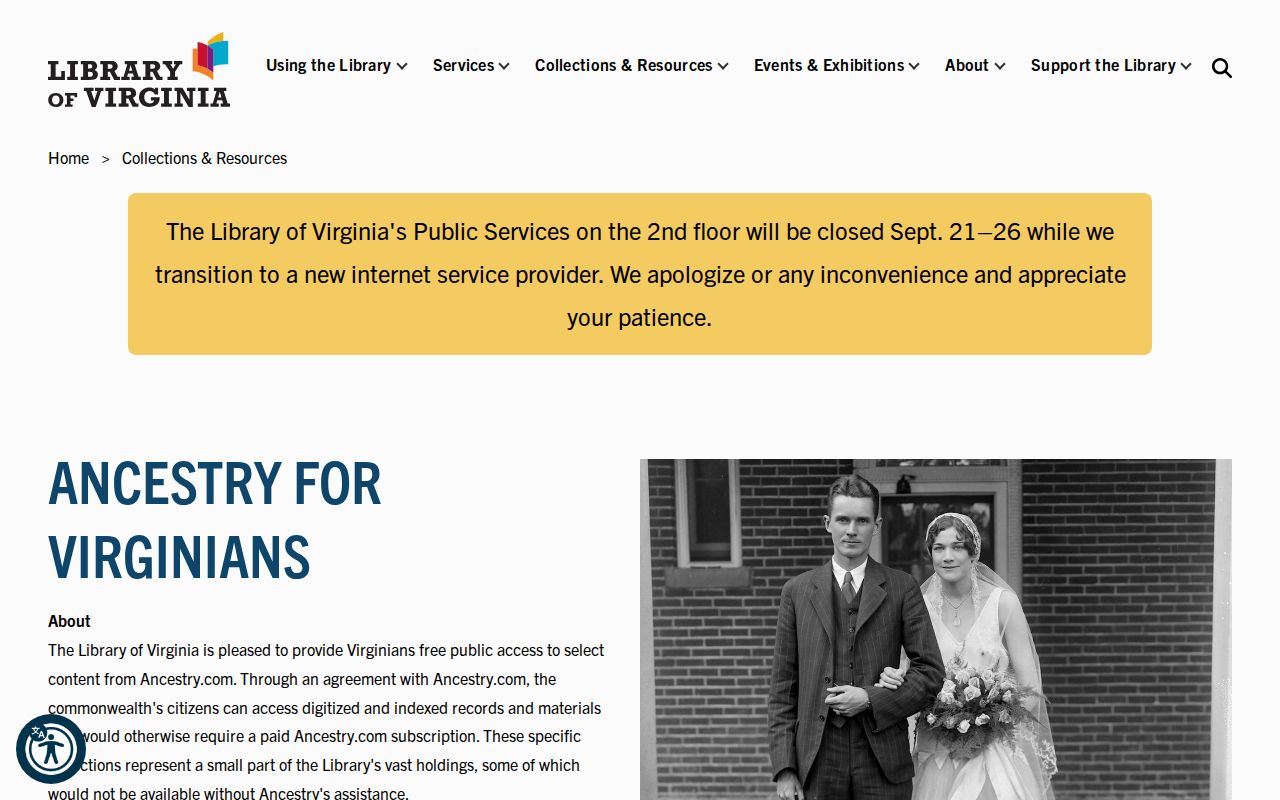
Library of Virginia Ancestry access for Virginians provides free Virginia access to selected directories from 1873 through 1960. “Selected” is the key word. It does not mean that every Richmond or suburban volume is digitized, and it does not convert a regional result into a Tuckahoe jurisdiction finding.
The Library of Virginia also provides the verified Henrico County VA125 microfilm guide. Ask whether a listed microfilm item is at the library or can be borrowed through interlibrary loan. That is the supported fallback when a needed county record book is not named in an online directory collection.
Library of Virginia access information describes the free Virginia route and the historical collections attached to it.
Use an online hit to identify a volume and page, then use the scan, repository copy, or microfilm route to resolve uncertain text.
Tuckahoe Directory Companions
Directories are not the only historical people source. Richmond Room also offers local newspapers, yearbooks, phone books, organization records, in-library Ancestry Library access, NewsBank routes for the Richmond Times-Dispatch, and Virginia Chronicle's digitized newspaper material. The Library of Virginia Site Index includes the regional Richmond Enquirer/Visitor Marriage & Obituary Index for 1804-1860, but a comprehensive Henrico obituary index was not located.
For an earlier family or land question, the Henrico County Historical Society genealogy service is open by appointment and offers basic help and referrals. Its page identifies the 1679 Henrico tithe list as the only known extant tithe list and one of the earliest surviving local records. It is a family-history route, not a current resident database. Henrico History Archives at Meadow Farm also holds county-history resources and the Sheppard Family Papers, 1770-1980, for assisted archival research.
The Historical Society genealogy page documents its early-record and research-contact route for Tuckahoe historical-directory follow-up.
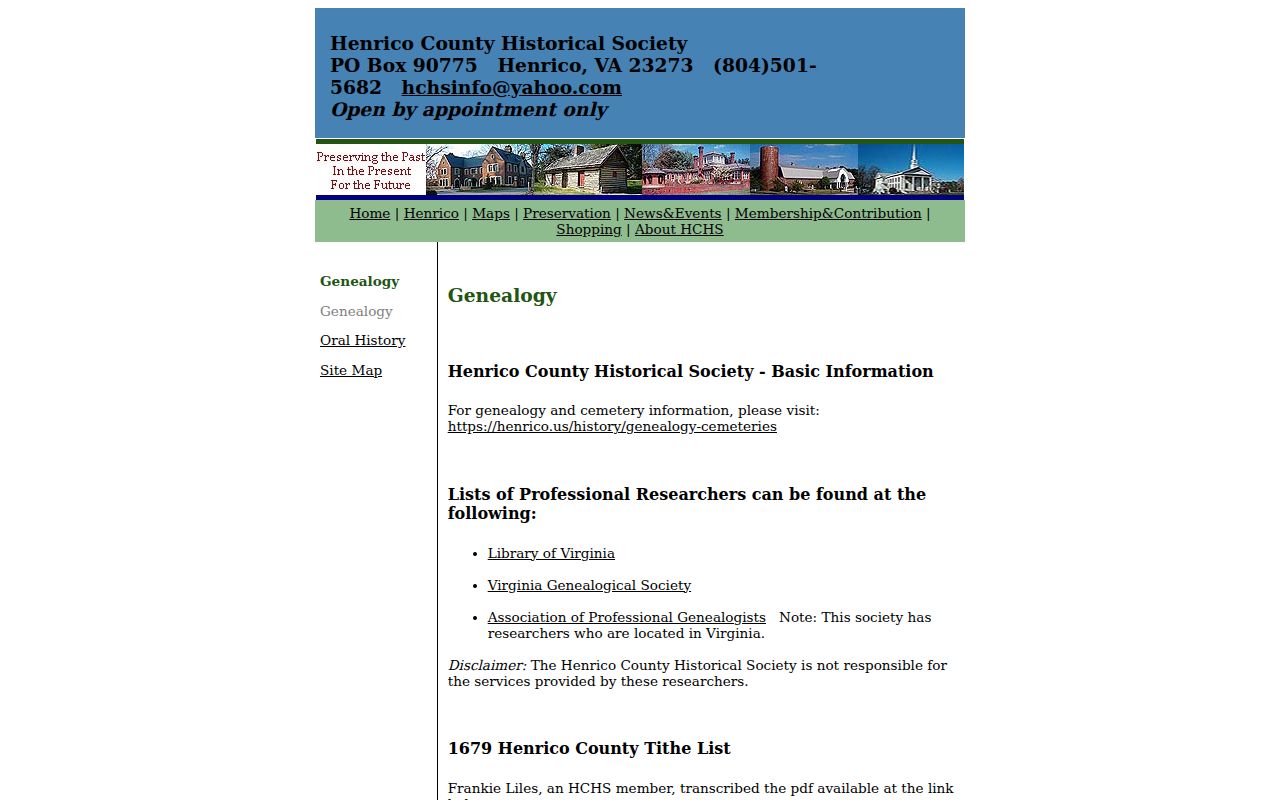
The society reported 164 cataloged cemeteries and about 3,500 computerized names by February 2003, a historical status report that should be checked directly for current availability.
Note: A newspaper, cemetery, or tithe-list clue can strengthen a directory trail, but each source has its own date, place, and coverage limits.
Tuckahoe Directory Gaps
Do not turn a missing listing into a conclusion. Richmond Room confirms phone books and local directories, yet the research did not locate a dedicated continuous Tuckahoe reverse-directory series. The documented online collection is selected, and publication or shelf coverage varies by year. Search the street-address section where present, then compare nearby house numbers, cross streets, old map references, and neighboring entries.
Henrico's records history adds another reason for care. The county lost many early records during the Revolutionary War, and almost all circuit-court records were lost in the April 3, 1865 evacuation fire. The loss history explains why a household trail may need directories, deeds, tax or probate material, census records, newspapers, and cemetery evidence rather than a single uninterrupted index.
Trace Tuckahoe Directories
A household timeline is built one volume at a time. Start with the most certain name and address, preserve the printed page, and record the year beside each observation. Federal censuses from 1790 through 1950 are released, with the National Archives 1950 census providing a public household-level checkpoint. Earlier census work needs Henrico magisterial, precinct, place, and address clues because Tuckahoe did not exist as a CDP in every historic period.
- Find the surname in a documented directory year and save the page citation, printed spelling, address, and place label.
- Check the next available year forward and back. Record a move, an added cross-reference, or a missing listing without assuming why it changed.
- For volumes after the street-address section appears, read the street and nearby house numbers to test the address context.
- Pair directory observations with the closest released census year, then compare the household and geography rather than relying on a name alone.
- Use deeds, newspapers, probate, or cemetery material to test a disappearance, death, relocation, or jurisdiction change.
A directory disappearance can mean a move, a death, a changed listing practice, an omitted neighborhood, or a missing volume. It does not identify a cause by itself. When the historical question becomes a current address-record question, the Tuckahoe streets reference has the separate modern parcel and address workflow.